Selling a Rural Property in Brant County: What Buyers Look For
TL;DR
- Buyers of a rural property in Brant County look beyond the house to the well, septic system, zoning, access, outbuildings, and ongoing costs.
- Gather records before listing, including permits, service invoices, water test results, well information, and details about major property systems.
- Do not make buyers guess whether an outbuilding, business use, apartment, or property feature is permitted.
- Clean up and repair with the likely rural buyer in mind, but do not hide flaws or spend heavily without a clear reason.
- Price the whole property against relevant rural sales, not just the house size or acreage.
Rural Buyers Need To Understand The Whole Property
Selling a rural property in Brant County means selling more than a house. Buyers may also be taking on a private well, septic system, outbuildings, a long driveway, fuel storage, drainage, trees, fences, and land uses they have never managed before.
That can make a good property feel harder to evaluate. It can also make unanswered questions feel expensive.
Your job is not to make every rural feature look perfect. It is to help buyers understand what is there, how it has been maintained, and which items still need their own investigation.
This guide covers the questions rural buyers often ask and the work that can make a listing easier to assess.
Table Of Contents
- Matt’s Stats
- Start With The Systems Buyers Cannot See
- Prepare The Well Information Before You List
- Make The Septic System Easier To Understand
- Check Zoning And Property Uses
- Show What The Outbuildings Actually Offer
- Explain Access, Utilities, And Ongoing Work
- Look At Drainage And Conservation Mapping
- Prepare The Rural Property For Photos And Showings
- Price A Rural Property In Brant County As A Whole
- Build A Clear Rural Listing Before Buyers Arrive
Matt’s Stats
| Rural Seller Check | Verified Fact | Why It Matters |
|---|---|---|
| Septic records | The County of Brant offers a sewage system records search for renovations and for buying or selling a home. | Existing records can help buyers and inspectors understand the system before making assumptions. |
| Well water | Grand Erie Public Health offers private well testing for total coliforms and E. coli and recommends testing every spring, summer, and fall. | A recent result gives buyers useful information, though it is only a snapshot of water quality. |
| Well records | Ontario provides an interactive well-record map and a request process when a record cannot be found online. | A well record may help identify construction details, but the province does not guarantee that every record is complete or current. |
| Zoning | The County’s zoning page provides an interactive map, zone rules, and a process for requesting a Building and Planning Compliance Certificate. | Rural Residential, Agricultural, and other zones can permit different uses. The exact property must be checked. |
| Conservation mapping | The GRCA’s property map shows regulated areas where construction or development may need a GRCA permit. | Buyers with plans for an addition, pool, grading work, or another project may need property-specific answers. |
Start With The Systems Buyers Cannot See
A freshly painted living room is easy to understand. A buried septic bed is not.
Rural buyers may be comfortable with country systems, or they may be moving from a fully serviced city property. Either way, they want to know what they are taking on.
Start by making a property file. Depending on the home, it may include:
- Well records and recent water test results.
- Septic permits, pumping receipts, inspection records, and repair invoices.
- Heating fuel, hydro, and other utility information.
- Generator, water treatment, sump pump, or alarm service records.
- Permits and plans for additions, finished spaces, decks, and outbuildings.
- Surveys, if available.
- Invoices and warranties for major work.
- Information about shared driveways, rights-of-way, leases, or rental equipment for your lawyer to review.
Do not worry if you do not have every document. Find out what can be obtained, then be clear about what is missing.
An organized file will not replace a buyer’s inspection or legal review. It can stop a simple record question from turning into a cloud over the whole property.

Prepare The Well Information Before Selling A Rural Property In Brant County
If the home uses a private well, buyers may ask about the well type, depth, location, age, water quality, water treatment equipment, past problems, and whether there are unused wells elsewhere on the land.
Start with the well record if one is available. Ontario provides an interactive well-record map. interactive well-record map
If the record cannot be found online, the province also provides a request form. request form
The province warns that its records may not be complete or current. Treat the record as useful background, not proof that answers every well question.
Grand Erie Public Health offers free testing for total coliforms and E. coli in private well water. It recommends testing each spring, summer, and fall. free testing for total coliforms and E. coli
That public health test does not cover chemicals such as sodium, nitrates, or lead. The same source directs owners to a private laboratory for other testing.
Before listing, consider gathering:
- The most recent bacteriological test result.
- A list of water treatment equipment and filter or lamp replacement dates.
- Service records for the pump, pressure tank, softener, or treatment system.
- The location of the active well and any known unused wells.
- Notes on any past water supply, odour, staining, or treatment concerns.
A clean test is helpful, but it is still a result from one sample on one date. Buyers may request their own test, flow test, or well inspection based on the property and their plans.
Make The Septic System Easier To Understand
A buyer cannot judge a septic system by how tidy the grass looks.
They may want to know the system’s location, installation date, approved capacity, maintenance history, last pump-out, and whether any additions or extra bedrooms changed the load placed on it.
The County of Brant says sewage system permits are required for new systems, replacements, repairs, and alterations. It also provides a records search for people buying or selling a home. sewage system permits and records search
Gather the permit or record, if available, plus pump-out and repair invoices. Make sure you know where the tank and bed are located so they are not hidden behind stored equipment, vehicles, or landscaping during a showing or inspection.
Avoid casual claims about how long a system will last or how many people it can serve. If there is a concern, get advice from a qualified septic professional.
The same applies to landscaping and structures near the system. A pool, deck, shed, parking area, or addition may matter to a buyer if it affects access to the tank or future replacement options.
Check Zoning And Property Uses
Rural does not describe one zoning category.
The County of Brant identifies Agricultural, Rural Residential, Suburban Residential, Residential Hamlet and Village, Natural Heritage, and other zones. Each has its own rules, and a property may also have a site-specific provision. County of Brant zoning
This matters when a listing includes or suggests:
- A home business.
- A second unit or separate living space.
- Livestock or horses.
- A large shop or storage use.
- Short-term accommodation.
- Future severance or development potential.
- Commercial equipment or vehicle storage.
Do not assume a long-standing use is permitted because it has been there for years. Confirm the zoning and gather permits or approvals that support how the property is marketed.
The County also offers a Building and Planning Compliance Certificate for due-diligence requests. Ask the County which records or certificate fit the questions attached to your property.
If the answer affects the sale, your lawyer should review how it is described and documented. A good listing is specific about what exists without promising a future use that has not been approved.
Show What The Outbuildings Actually Offer
A shop, barn, drive shed, detached garage, or greenhouse can attract the right buyer. It can also create a long list of questions.
Buyers may want to understand:
- Approximate dimensions and construction.
- Electrical service and heating.
- Water supply and drainage.
- Roof and foundation condition.
- Access for vehicles or equipment.
- Permits and approved use.
- Insurance considerations.
- What equipment or fixtures are included.
Clean the building enough that buyers can see the walls, floor, panel, doors, and structure. Remove waste, unsafe materials, and items that block access.
Do not stage a working rural building until it loses all meaning. Buyers are not offended by a tractor being in a drive shed. They may be concerned if they cannot see the floor.
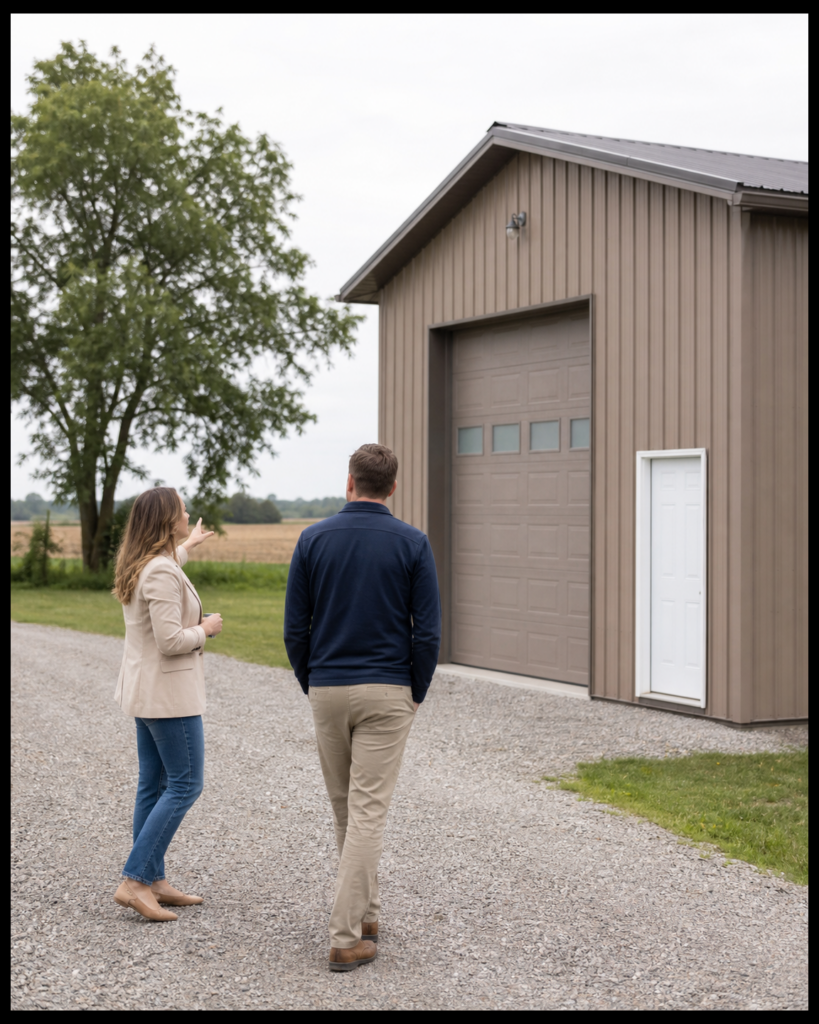
If a building has no permit record, an unfinished project, unusual wiring, or visible damage, deal with the question before listing. That may mean finding records, getting qualified advice, repairing the issue, or pricing and marketing with the condition in mind.
Explain Access, Utilities, And Ongoing Work
Rural buyers often think about daily ownership in a way city buyers do not need to.
Prepare clear answers about:
- Whether the road is public or private.
- Who maintains and clears the driveway or road.
- Any shared access or registered right-of-way.
- Garbage and recycling arrangements.
- Internet and mobile service actually used at the property.
- Heating source, rental equipment, and typical service schedule.
- Backup power and which systems it serves.
- Propane or oil tank ownership and service records.
- Fence ownership and maintenance arrangements.
- Regular tree, lane, ditch, or snow work.
For utility costs, use real bills and explain the period they cover. Do not offer one round number without context when fuel purchases, weather, household size, workshop use, or electric vehicles can change the total.
Test internet and mobile service in the places where buyers may need it. A provider’s coverage claim is less useful than knowing what service is installed and how it performs in the house and outbuildings.
Look At Drainage And Conservation Mapping
Water movement matters on any lot, but a larger rural property can have more features to understand. Walk the land and note ditches, culverts, swales, low areas, ponds, slopes, field drainage, sump discharge, and places where water collects after heavy rain.
Keep drainage paths visible and accessible. Gather records for significant grading, drainage, shoreline, or watercourse work if they exist.
The Grand River Conservation Authority provides a property map that identifies regulated areas. The GRCA says construction or development in a regulated area may need its permit. GRCA property map
A mapped area does not automatically make a property difficult to sell. It tells you that buyers with plans for an addition, pool, new building, grading change, or other project may need to speak with the GRCA and the County.
Do not guess what a map colour means. Get property-specific guidance when a proposed use matters to the listing.
Prepare The Rural Property For Photos And Showings
When selling a rural property in Brant County, the land and support buildings need a listing plan too.
Start with safety and access. Buyers should be able to walk the areas you expect them to evaluate without climbing over debris, loose boards, hidden holes, or stored machinery.
Then focus on clarity:
- Trim enough vegetation to show important boundaries and features without pretending you own land beyond them.
- Clear access to the well, septic area, utility equipment, electrical panels, and outbuildings.
- Repair gates, loose railings, broken exterior lights, and obvious trip hazards.
- Label controls or systems that are unfamiliar to most buyers.
- Remove scrap, abandoned containers, and materials that raise environmental questions.
- Decide which equipment, implements, fuel tanks, and fixtures are included or excluded.
My guide to what buyers notice when selling your home explains why basic maintenance and clear presentation often matter more than cosmetic extras. what buyers notice when selling your home
Photos should show how the property works. Include the approach, driveway, house, useful outdoor areas, significant buildings, and the relationship between them.
Rural listing exposure also needs more than a front elevation and room count. I have written about how listing exposure goes beyond Realtor.ca because the right buyer first needs to understand why the property fits their search. how listing exposure goes beyond Realtor.ca
Price A Rural Property In Brant County As A Whole
Pricing a rural property in Brant County is not a matter of adding a fixed amount for each acre, barn, or workshop.
Buyers weigh the whole package:
- Location and drive time.
- Lot size, shape, privacy, and usable land.
- House size, condition, and layout.
- Well and septic information.
- Outbuilding condition and approved use.
- Heating, internet, and ongoing maintenance.
- Road access and shared arrangements.
- Zoning and conservation constraints.
- Recent sales of properties with similar features.
A large building may add value for one buyer and look like a maintenance bill to another. Extra land can be appealing, but its use, access, drainage, and zoning matter.
This is why relevant comparable sales matter more than a simple price-per-square-foot calculation. My article on pricing your home correctly the first time covers the risk of starting from the number you want instead of the market evidence. pricing your home correctly the first time
[Chart suggestion: Rural Property Comparison Scorecard, table, data needed: recent comparable sale price, location, lot size, usable land, house size and condition, well and septic details, outbuildings, access, utilities, zoning, and sale date, why it helps the reader: it shows why two rural homes with similar acreage may not compete for the same buyer.]
Build A Clear Rural Listing Before Buyers Arrive
Selling a rural property in Brant County gets easier when buyers can see what they are evaluating. The well, septic system, zoning, buildings, access, utilities, drainage, maintenance history, and records all affect confidence.
You do not need to order every possible report before listing. You do need a plan for the questions your property is likely to raise.
Have questions about preparing a Brant County rural home for sale? Contact me before you start spending on repairs or guessing at the price. I can help you identify the likely buyer, compare relevant sales, and organize the property details that deserve attention before the listing goes live.