Brantford SEC Financing: How the City Plans to Pay for the New Arena
TL;DR
- The approved Sports and Entertainment Centre budget is $152 million.
- The City’s plan uses a $140 million, 30-year debenture, supported by a dedicated SEC reserve.
- The model depends on land sales, fundraising, naming rights, operator contributions, accommodation tax revenue, casino revenue and new downtown tax growth.
- The reserve stays above zero in the City’s forecast, but its projected balance falls to about $263,000 in 2040 before recovering.
- “No contribution from existing taxpayers” describes the capital financing plan. It is not a promise that every forecast will land exactly as modelled.
What the Brantford SEC financing plan actually says
Brantford SEC financing is easier to understand when you separate the construction loan, the long-term debenture and the reserve that supports the payments. The City has approved a $152 million facility and plans to borrow $140 million over 30 years. The rest of the capital plan depends on money flowing into a dedicated Sports and Entertainment Centre reserve.
This article explains where that money is expected to come from, why the reserve balance matters and which projections residents should keep watching. It also updates the original December 2025 draft now that construction is underway.
Matt’s Stats
- Council-approved project budget: $152 Million
- Fixed seats in the approved design: 5,342
- Net programmed floor area: 189,850 sqft
- Bulldogs’ signed initial lease term: 15 Years plus 5 options of 5 years each
- Projected debenture annual payment:
Update: Aug 15th 2026: SEC is under construction with foundations and rink slab installation underway.
Click to view the City’s SEC project page
What the City’s financing model assumes
The financing figures below are important, but they belong in a forecast table rather than in Matt’s Stats. They describe the City’s approved plan.
| Financing assumption | Modelled amount or timing |
|---|---|
| Planned municipal debenture | $140 million over 30 years |
| Annual debt servicing | $8,020,577 |
| Powerline Road sale proceeds | $44 million in 2030 |
| Lowest projected reserve balance | $263,025 in 2040 |
| Projected reserve balance in 2042 | $2,255,245 |
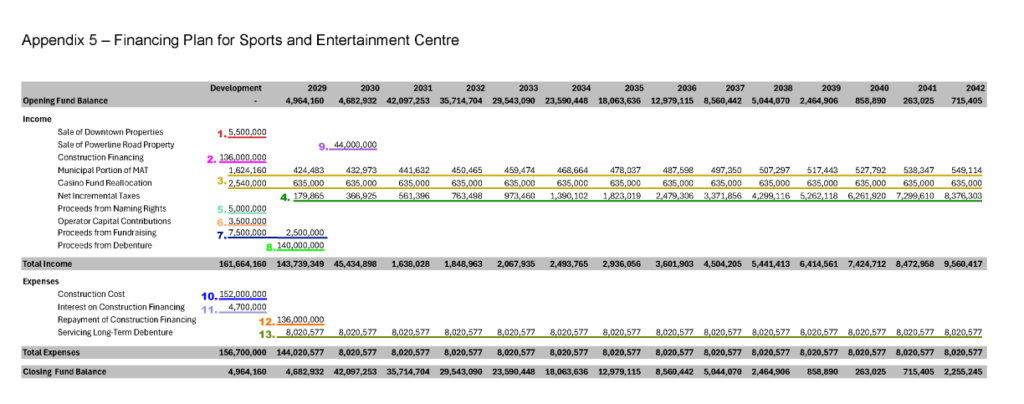
Borrowing and project costs: (2) $136 million in construction financing during development; (11) $4.7 million in construction-financing interest; (12) repayment of the $136 million construction financing in 2029; (8) $140 million in long-term debenture proceeds in 2029; (13) modelled annual long-term debt servicing of $8,020,577; and (10) the $152 million construction cost.
Money flowing into the reserve: (1) $5.5 million from downtown City-property sales; (9) a projected $44 million Powerline Road sale in 2030; (5) $5 million from naming rights; (6) $3.5 million in operator capital contributions; (7) $7.5 million in fundraising during development plus $2.5 million in 2029; (3) Municipal Accommodation Tax revenue; and (4) projected net incremental taxes. The casino reallocation is also shown in the table, although it does not have its own numbered colour marker.
These are figures from the City’s December 2025 financing model. The bottom row tracks the projected closing reserve balance; it is not a published current bank balance or a total of money already received.
The short version of the Brantford SEC financing plan
The City does not plan to write one $152 million cheque. The build is financed in stages.
First, the model provides $136 million in construction financing. This includes $4.7 million in interest during that phase. This temporary financing pays construction costs before the long-term debt is in place.
Next, the City plans to issue a $140 million municipal debenture. A debenture is long-term municipal debt. The plan spreads repayment over 30 years and models annual debt servicing of $8,020,577.
The dedicated SEC reserve is then used to support those annual payments. Money enters the reserve from several sources. Debt service and other project costs come out. The City’s test is straightforward: does the reserve have enough money to cover the planned payments without requiring a capital contribution from existing taxpayers?
That answer depends on the forecasted inflows arriving on time and near the amounts shown.
Where the SEC reserve money is expected to come from
The reserve is not funded by one source. The City has spread the plan across property sales, visitor-related revenue, private fundraising and future downtown tax growth.
The financing appendix schedules:
- $5.5 million from the sale of downtown City properties.
- A projected $44 million from the sale of the Powerline Road property in 2030.
- $5 million from naming rights.
- $3.5 million from operator capital contributions.
- $7.5 million in fundraising during development, plus another $2.5 million in 2029.
- $1,624,160 from the City’s portion of the Municipal Accommodation Tax during development, followed by annual amounts that rise from $424,483 to $549,114 in the years shown.
- $2.54 million in reallocated casino revenue during development, followed by $635,000 per year.
- Net incremental taxes from new lower downtown development, growing from $179,865 in 2029 to $8,376,303 in 2042.
This mix matters. If one source arrives late, other reserve money may cover the gap for a period. A mix of sources does not remove the risk. The Powerline Road sale and future downtown tax growth remain large assumptions in the forecast.
Why the reserve balance matters
The reserve balance is the clearest scorecard in the plan. The City’s forecast keeps it above zero through 2042. That supports the statement that the capital plan does not require a contribution from existing taxpayers.
Still, “above zero” can mean a large cushion or a narrow one. The projected closing balance falls from more than $42 million in 2030 to $263,025 in 2040. It then rises to $715,405 in 2041 and $2,255,245 in 2042.
That low point is worth watching. A modest delay in a land sale, a weaker fundraising result or slower downtown development could change the timing. The model may still work, but residents should judge it against actual reserve reports, not the original spreadsheet alone.
The City says that by 2042, net incremental tax revenue from lower downtown development is projected to exceed annual debt servicing. If that happens, revenue such as the Municipal Accommodation Tax may be available for other priorities again.
the City’s current SEC questions and answers
What “no contribution from existing taxpayers” means
The City’s wording is narrower than saying the arena is free or that property taxes can never be affected.
The capital plan is designed to use a dedicated reserve instead of an added contribution from the existing tax base. Some of the reserve money is still public money. Municipal Accommodation Tax revenue, casino revenue and proceeds from City land could support other eligible priorities if Council chose a different path.
There is also a difference between building the facility and operating it. The December 2025 financing appendix explains the capital cost and debt service. Future operating budgets will show whether event revenue, lease payments and facility expenses perform as expected.
The fair reading is this: the City has presented a capital model that avoids a new contribution from existing taxpayers, provided the listed revenues and timing hold. That is a stronger explanation than simply saying “taxpayers are not paying for it.”
UPDATE: What has changed since Council approved the project
Council approved the final design and revised $152 million budget on December 4, 2025. The City and the Brantford Bulldogs also signed a 15-year lease with five separate five-year extension options.
Groundbreaking took place on February 23, 2026, followed by job trailers on March 13. Early work included stormwater work, ground improvement and preparing the subgrade. Foundations and rink slab work are underway.
Follow the City’s construction updates
The question is no longer whether Council will proceed but whether construction costs and reserve revenues continue to track the approved plan.
The five numbers Brantford residents should keep watching
1. The final Powerline Road sale proceeds
The plan uses $44 million in 2030. That is the largest single non-debt inflow in the appendix. Residents should watch the sale timing and final net proceeds.
2. Fundraising and naming rights
The model schedules $10 million in fundraising across development and 2029, plus $5 million in naming rights. Announced commitments and cash received are not always the same thing, so public updates should separate them.
3. Net incremental downtown taxes
The forecast depends more heavily on new downtown tax revenue over time. By 2042, the plan shows $8.38 million from this source. That means development timing, assessment growth and occupancy will matter.
4. The final borrowing terms
The appendix models annual debt servicing of $8.02 million. When the long-term debenture is issued, residents should compare its actual rate, term and annual payment with the model.
What this could mean for downtown real estate
A large public project can change traffic patterns, construction access, parking demand and development interest. It does not automatically raise every nearby property value.
For downtown owners and buyers, the practical signals will be completed housing and commercial projects, new tenants, foot traffic outside game nights and how well parking and street access work. Those results will matter more than a rendering or an economic-impact estimate.
My earlier article looked at the investment case and the risks before final approval:
-
Brantford SEC Financing: How the City Plans to Pay for the New Arena
Brantford SEC financing explained: the $140M debenture, reserve fund, Powerline Road sale, annual debt payments and risks residents should watch.
Have questions about the Brantford SEC financing plan?
If you are trying to understand how the new arena, downtown construction or nearby development could affect a property decision, contact me. I can help you separate the approved facts from the projections and look at what matters for your specific location.